
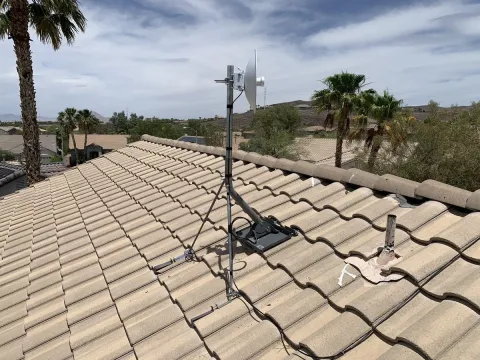
Low ping in a Las Vegas match comes from the path the packet takes, not from a bigger speed-test number. Two choices do that work. The last hop can be a line-of-sight microwave shot into a network we own. Once the packet is on AS27501, Noction IRP measures which upstream is actually healthy toward the game and steers the exit.
What an April 2026 routing failure showed
On April 14, 2026, during Super Typhoon Sinlaku, a public monitor watched the round trip between Saipan and Guam jump from about 8 ms to about 110 ms. The islands are about 200 km apart. The cable was still there. A local peering session had dropped, and ordinary BGP fell back through Los Angeles and Arelion, then came back across the Pacific. GeoCables published the trace: a trip of about 200 km took a detour of about 12,000 km, and the packets still arrived.
That detour did not hit Las Vegas customers. It is the failure mode that shows up in a match as rubber-banding. A speed test can stay fast, because a nearby test server never took the long exit, while the game prefix did.
Game forums showed the same split this year. These are player reports, not an outage we measured, and they were not on our network. On May 1, 2026, a downtown Los Angeles player on AT&T Fiber wrote on the Overwatch forums that West-region latency had moved from about 20 ms to a range of 100–800 ms. A speed test on that connection still showed about 800 Mbps down and 400 Mbps up. Fortnite on the same line was fine. The post pointed at the path into the cloud network hosting Overwatch West, not at the apartment Wi-Fi. On October 3, 2026, a World of Warcraft player on Spectrum posted a traceroute toward a Blizzard gateway in Los Angeles. Hops inside Spectrum stayed around 10–20 ms. The handoff into the game network was where the trace degraded, and another player in the thread only improved the number for a while by switching to IPv6. The plan speed had not changed. The route to the server had.
How isp.net uses Noction on AS27501
Public bandwidth on isp.net is multi-homed. We blend Cogent, Zayo, Cox, and CenturyLink (Lumen) on multiple 100 Gbps uplinks. Cox in that list is core transit. It is not a resale of Cox coax on the street. We do not resell Cox, Spectrum, or AT&T last mile. The network is AS27501, independently owned, with two downtown Las Vegas datacenters. The same routing is described on the colocation page and the ownership page.
Noction IRP sits on our routing, not in the house and not in a customer's rack. It probes prefixes across those upstreams and measures loss, latency, and congestion, then announces the healthier route to our edge routers. Ordinary BGP only follows what neighbors advertise. It does not time the path, so a neighbor can keep advertising a route that is lossy or long. When the optimizer is not applying an improvement, the routers stay on the providers' normal advertisements. We do not publish a vendor average as if it were a measurement of Las Vegas matches.
A West-region match often ends in Los Angeles, or on a cloud region that peers there. Las Vegas is a short ground hop from that market when the exit is the right one. Noction's job is to notice when one of the four upstreams is the clean exit for that prefix, and when another is the detour.
Why the microwave hop is the other half
Fiber already in the building, on a short route, can still be the lower number. We do not publish a city ranking that says microwave wins at every address.
Where the glass is missing, or the street route passes through a long chain of equipment before it reaches us, microwave is the straight shot. A dish about the size of a dinner plate aims at a tower we operate. The hop is ground-based, so it is not a satellite round trip. It is one line of sight into AS27501, and then the optimizer picks the upstream. Speeds go up to 10 Gbps only where line of sight and spectrum allow. If we cannot see the address, we do not sell the radio: No Signal, No Charge. Nevada electrical work on the install is under C-2 license #0093716. Details are on microwave and fixed wireless. Where fiber still wins is on fiber versus microwave.
What still belongs in the house
The 2026 reports were not Wi-Fi stories. Those connections were already fast, and in more than one case already on a wire. Inside the house, Wi-Fi is still the usual source of jitter, and a console on a wire removes that variable. A large download on another device can fill the link even when the route is clean. Picking the West server, when the game allows it, keeps the destination in the market our upstreams actually reach. None of that repairs a BGP detour. It stops the house from adding a second delay.
Home service is HomeNet. Qualifying residential plans have no data cap, and price-for-life applies on qualifying HomeNet plans. Coverage is a survey, not a ZIP-code promise: see the coverage map, or call or text 702.900.0000.
Gaming lag and routing questions
A speed test often lands on a nearby server. The game lands on a specific prefix, sometimes in Los Angeles or on a cloud region that peers there. On April 14, 2026, a monitored path of about 200 km jumped from about 8 ms to about 110 ms because ordinary BGP fell back through Los Angeles. The cable had not failed. A fast speed test does not time that exit.
On May 1, 2026, a downtown Los Angeles player on AT&T Fiber wrote that Overwatch West latency moved from about 20 ms to 100–800 ms while a speed test still showed about 800 Mbps down. On October 3, 2026, a World of Warcraft player on Spectrum posted a traceroute that stayed near 10–20 ms inside the cable network and then degraded at a Blizzard gateway in Los Angeles. These are player reports on the game forums. They are not an isp.net measurement, and they were not on our network.
Noction IRP runs on isp.net routing, AS27501. It probes prefixes across Cogent, Zayo, Cox, and CenturyLink (Lumen) and measures loss, latency, and congestion, then steers the edge routers to the healthier path. Ordinary BGP does not make that check. When Noction is not applying an improvement, traffic stays on the providers' normal advertisements. Cox in the blend is core transit, not street coax.
No. Fiber already in the building on a short route can still be the lower number. Microwave is the short path when the street route is long or the glass is not there: one line-of-sight hop into our network, ground-based, not a satellite hop. Service goes up to 10 Gbps only where line of sight and spectrum allow. We do not publish a citywide latency ranking.
A VPN sometimes leaves through a different network and dodges a bad exit, which is why players try one during a routing incident. It adds its own hop, and it is not a product we sell for this. On our network the exit choice is Noction, measured across four upstreams, without a tunnel in the house.
A match is a small, steady flow. Latency and loss decide whether a shot lands on time. A plan sold on a large download number does not time the path to the server. If the address qualifies, the survey sets the speed. We do not promise 10 Gbps on every roof.
We survey the address for line of sight. Call or text 702.900.0000. If we cannot see a tower, there is no charge for a signal we cannot deliver. Nevada installs are done under C-2 license #0093716.